 |
ManiVault 1.0.0
A Flexible and Extensible Visual Analytics Framework for High-Dimensional Data
|
|
ManiVault 1.0.0
A Flexible and Extensible Visual Analytics Framework for High-Dimensional Data
|
#include <Texture.h>
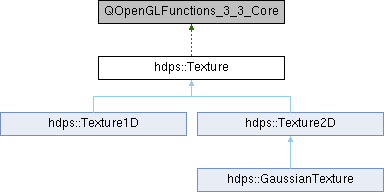
Public Member Functions | |
| Texture (GLenum target) | |
| void | create () |
| void | destroy () |
| void | bind (unsigned int textureUnit) |
| void | bind () |
| void | release () |
| bool | isCreated () |
| GLuint | getHandle () |
Protected Attributes | |
| const unsigned int | MAX_TEXTURE_UNITS = 16 |
| bool | _created |
| GLuint | _handle |
| GLenum | _target |
Base texture class. Contains most of the functionality, but can only be used through one of the sub-classes. The texture subclasses provide the specifics of the operations performed on the texture (such as dimensionality). It is wise to only call functions in this class when an OpenGL context is current and active, otherwise their behaviour is undefined.
|
inline |
Texture constructor
| target | The GLenum specifying the target of texture operations. GL_TEXTURE_1D, GL_TEXTURE_2D and GL_TEXTURE_3D are accepted. |
|
inline |
Binds the texture to the active texture unit.
|
inline |
Binds the texture to the given texture unit.
| textureUnit | The texture unit should be a value in the range [0-16). One shouldn't try to pass OpenGL texture units in here, as the given value gets added to GL_TEXTURE0. |
|
inline |
Initializes the use of OpenGL functions in this context and generates the raw OpenGL ID of the texture. This function should be called before doing any other texture operations and only when an OpenGL context is current and active.
|
inline |
Deletes the OpenGL texture ID and invalidates this texture until create() is called again.
|
inline |
Return the raw OpenGL texture ID.
|
inline |
Return whether the texture has been allocated
|
inline |
Unbinds the texture by binding the default (0) texture.
|
protected |
|
protected |
|
protected |
|
protected |
 1.9.8
1.9.8